

Connecting District 123
Connections are coming to HD123 — but only if we fight for real fiber, not a satellite dish that goes dark every time the power does

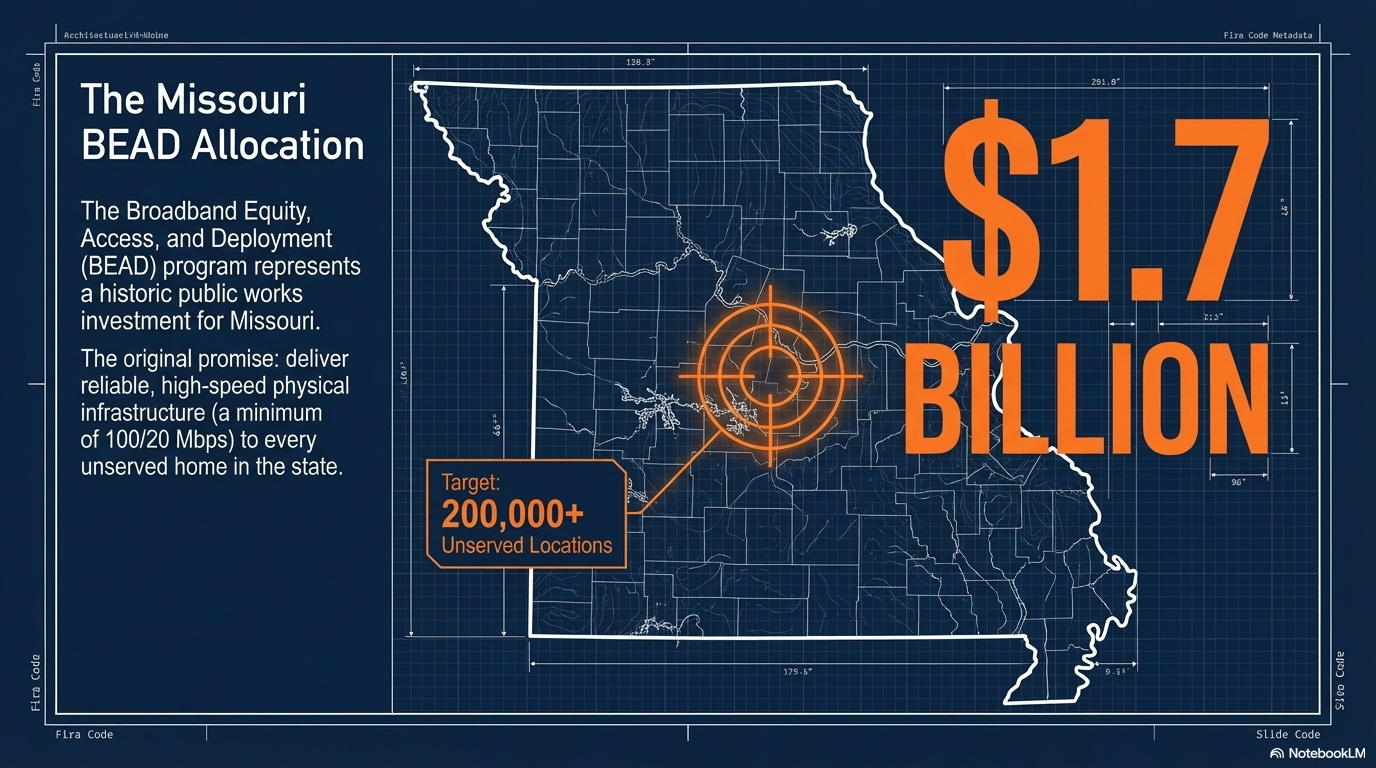
YOUR BROADBAND MONEY IS ABOUT TO LEAVE MISSOURI.
I have 1 GB fiber internet at my house in Camden County.
Co-Mo Connect put it there working with SW Electric Co-Op Infrastructure.
It is fast, it is reliable, and it stays on through the kind of weather that knocks everything else out.
Other folks in this district are road are on satellite, cell towers, DSL, or nothing. Same District. Same community. Different technological world.
There is $1.7 billion in federal BEAD money — Broadband Equity, Access, and Deployment — sitting in limbo right now, theoretically meant to close that gap.
Missouri got the third largest allocation in the country.
Only California and Texas got more.
So why isn’t the gap closing? Why doesn’t the average Missourian know about this program, and why haven’t I heard of anyone Jeff City asking the right questions?
Well- I have been asking around... and this is what I’ve learned.
First — “Hutch You Worked In Air Defense, We Know!”
Well, did you know while working Air Defense for 20 full years in the military- I also spent 19 of those 20 years in the United States Air Force as an Advanced JICC Operator.
JICC stands for Joint Interface Control Cell.
In plain language: I was a multi-platform network architect and manager.
My job was making sure that communications systems from different branches, different nations, and different technology generations could talk to each other reliably under pressure — when failure was not an option.
Shortest description: I got targets to Jets and let Generals see in real time how those Jets would prosecute those targets.
I know the difference between a dedicated circuit and a shared pipe.
I know what happens when a network degrades under real load versus what it can do in ideal conditions.
I know how to read a coverage map and tell you what it isn’t showing you.
Most people talking about broadband policy in Jeff City don’t have that background.
I’m not saying that to be harsh.
I’m saying it because it matters — and because the gaps I’m about to describe are exactly the kind of thing that only shows up when someone who has actually built and managed networks looks at the plan.
Here’s what the plan is currently missing
The Trump administration restructured BEAD in June 2025, eliminating the fiber preference and declaring the program “technology neutral.” That opened the door for Starlink and Amazon’s Kuiper to compete for the same dollars that were supposed to build permanent fiber infrastructure.
On paper, that sounds like competition. Capitalism at its finest.
In practice, it is a technical disaster.
Here’s why — in plain terms.
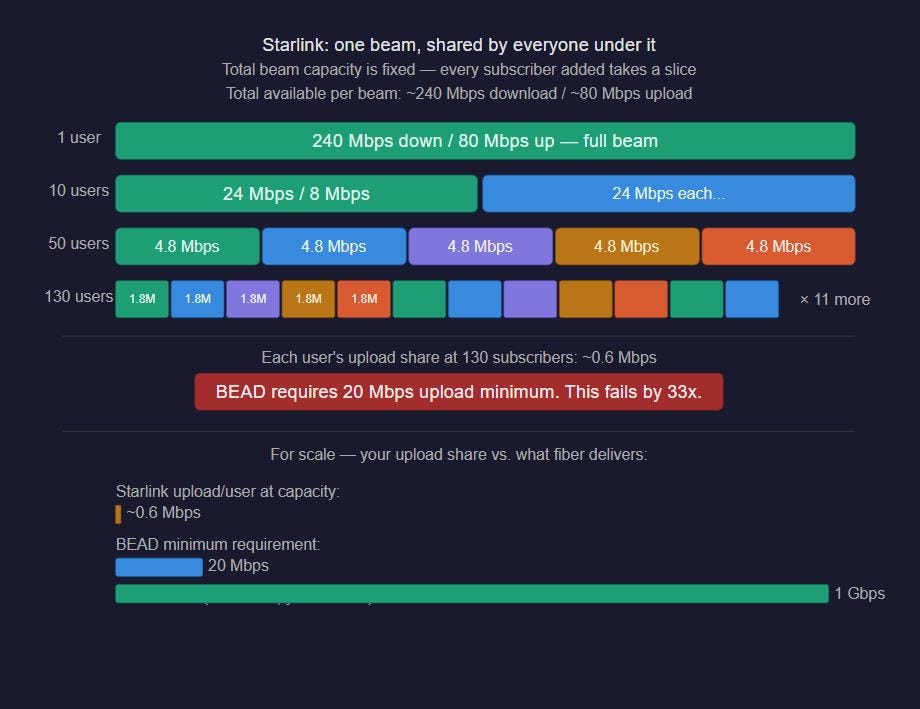
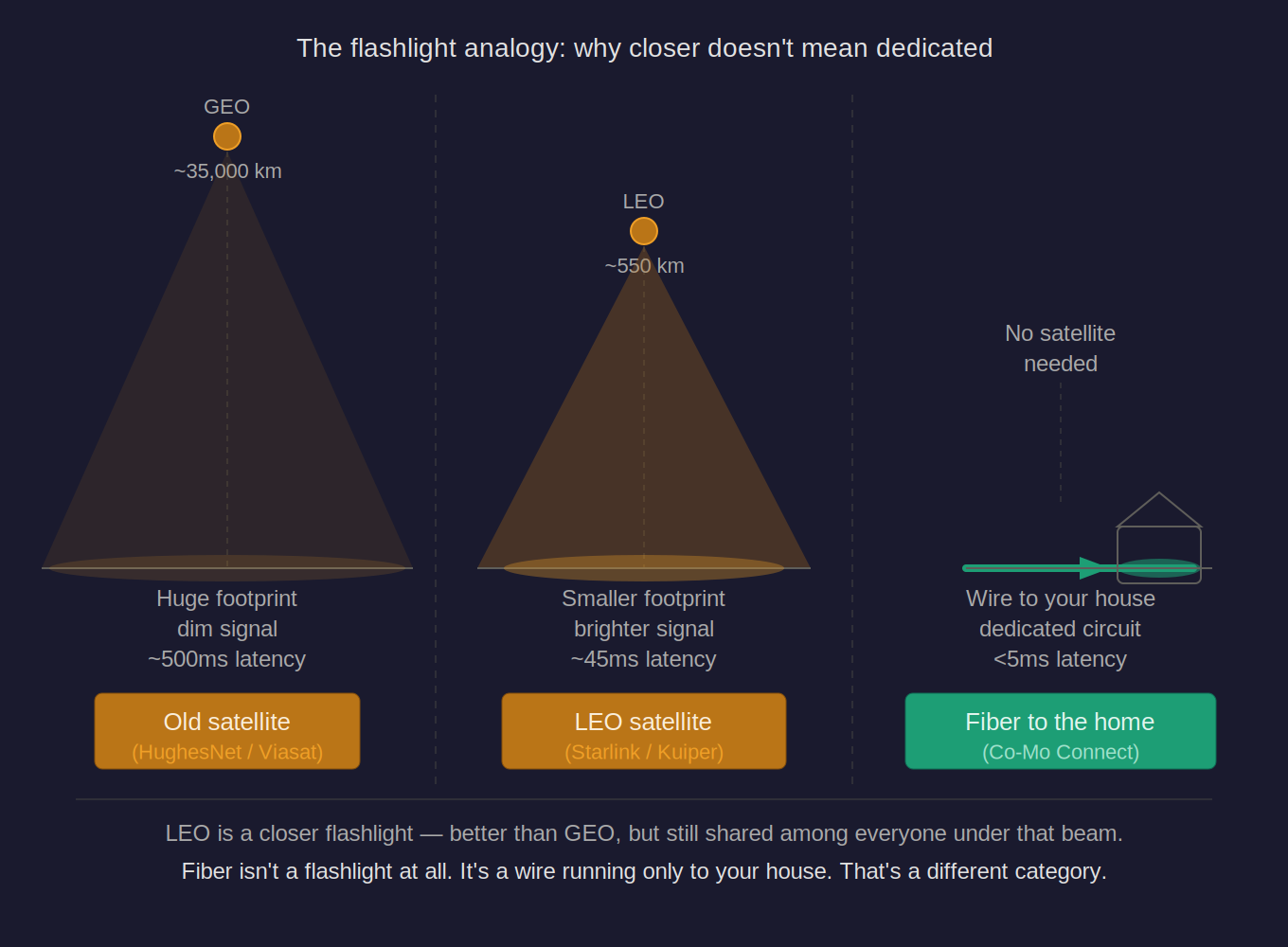
Satellite is a shared pipe.
Fiber to your home is not.
When you have Co-Mo Connect fiber, that bandwidth is yours.
Your neighbor streaming a movie doesn’t slow you down. A hundred new people moving to the lake doesn’t degrade your service. The pipe is dedicated to your house.
Satellite is different.
Every subscriber under that satellite’s coverage beam is sharing the same capacity.
The more people who sign up in your area, the less each person gets.
When a storm keeps everyone home on a Tuesday and every dish in your coverage cell is online at once, everyone slows down together.
That is not an infrastructure problem — it is the physics of a shared medium, and no amount of marketing changes it.
Then there’s the geography problem.
Satellite needs a clear view of the sky. The Ozarks are not a parking lot. Deep wooded coves. Thick tree canopies. Rolling hills.
Many homes at the lake are tucked into the landscape by design.
A single tree between your dish and the sky degrades your signal.
Ice on the dish reduces reception.
And when a wind or ice storm takes out your power — which happens out here — your satellite internet goes dark at the exact moment you need emergency communication.
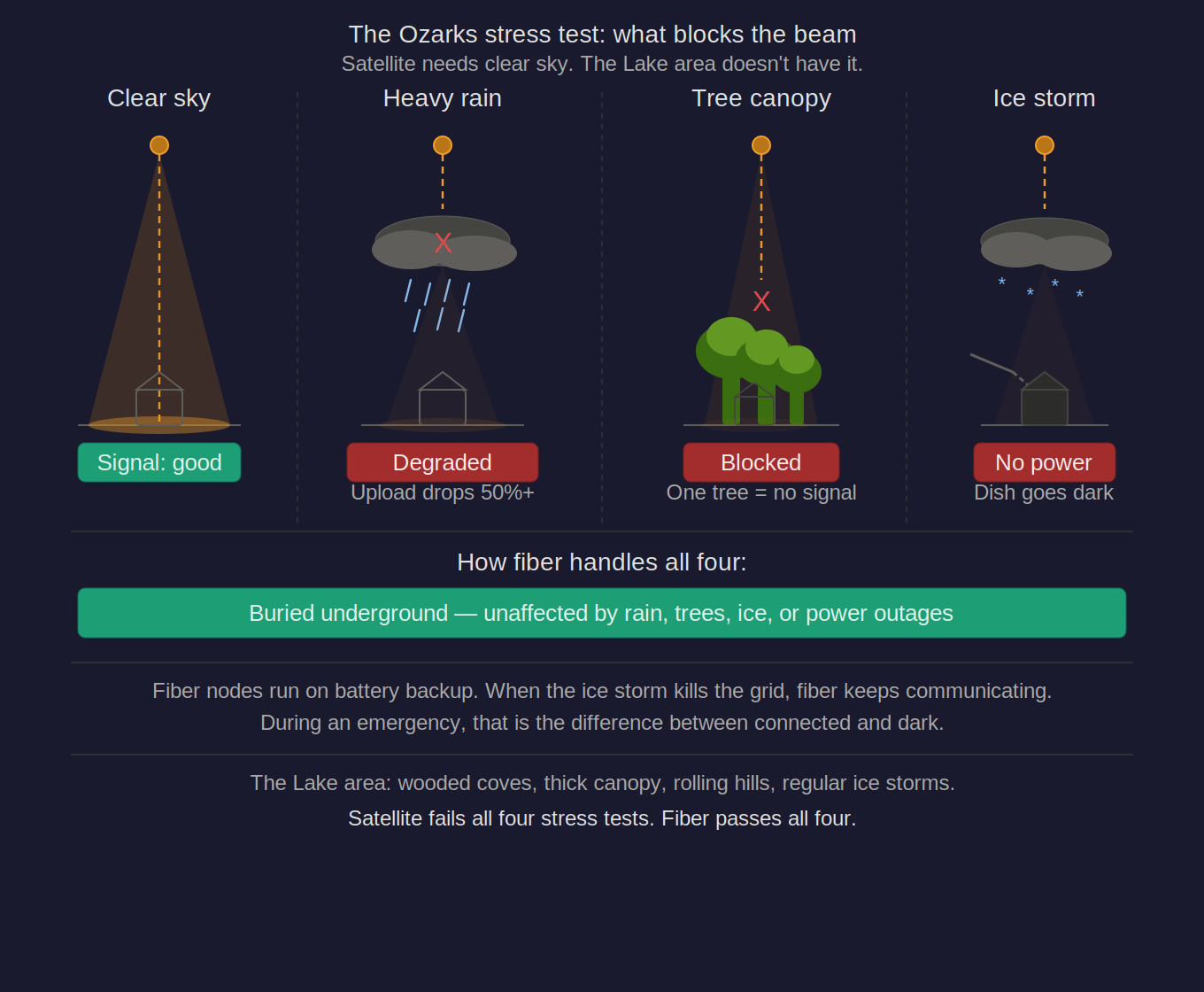
Satellite Does Not have a Battery Backup.
“But Hutch, when my power goes out, so does my internet!”
Yes, friend — it does, for two reasons.
First, your home’s modem doesn’t have a UPS (Uninterruptible Power Supply) attached for backup power.
Second, most of the fiber lines out here are still run on poles — and we’ll get to that.
But the deeper point is this: fiber infrastructure nodes can be maintained on battery backup during an outage.
A satellite dish cannot.
When the grid goes down, satellite internet dies instantly — at the exact moment you need emergency communication most.
Solar Weather
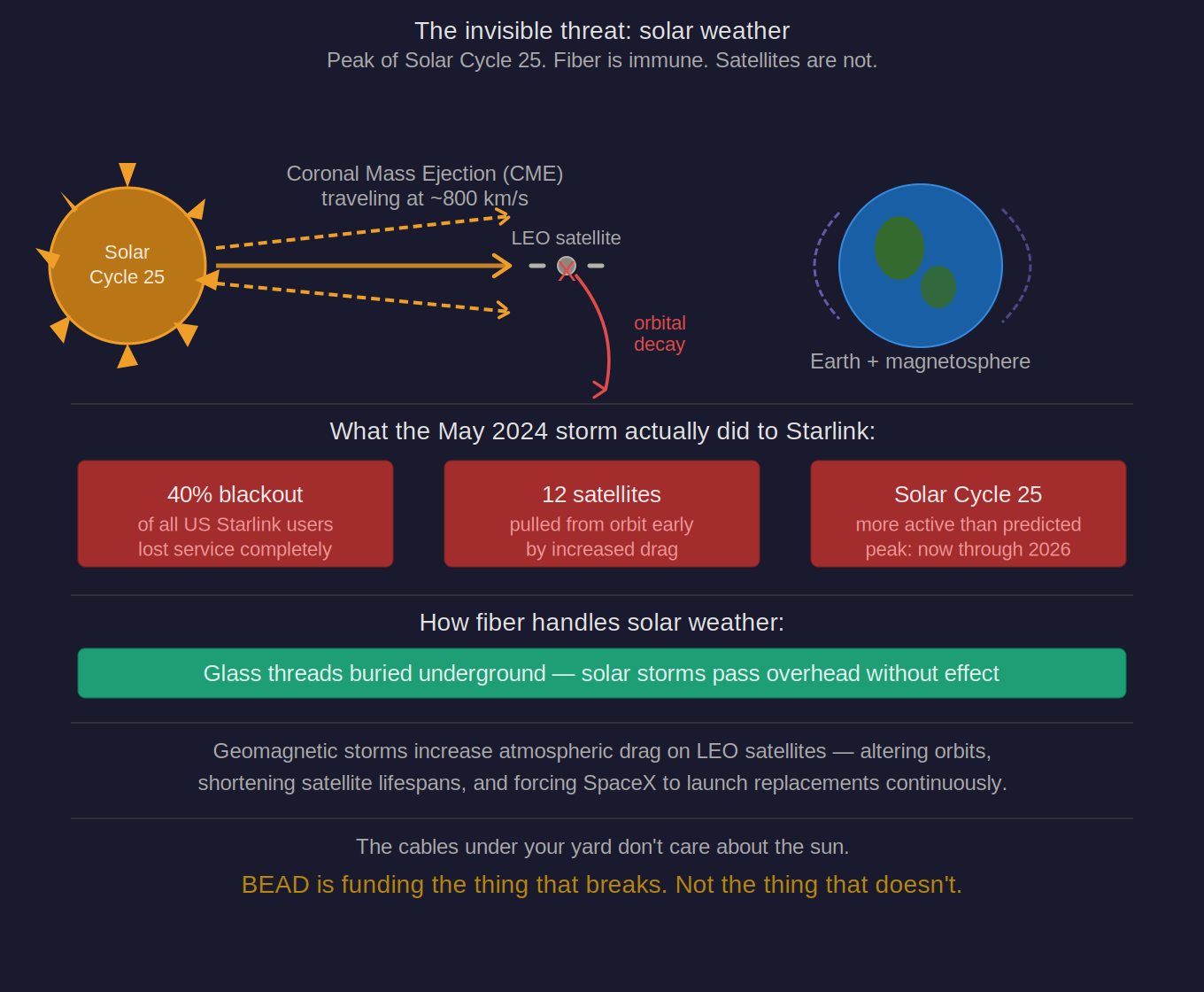
We are at the peak of Solar Cycle 25. In May 2024, a major geomagnetic storm blacked out 40% of Starlink users nationwide and knocked 12 satellites out of orbit early. Buried fiber is completely immune to solar weather.
The cables under your yard don’t care about the sun.
The satellites overhead very much do.
Here’s something that should make every rural Missourian angry.
BEAD funding is allocated based on FCC broadband maps.
Those maps are built from provider self-reporting — meaning a satellite company can claim coverage over a huge area, and that entire area gets counted as “served” and removed from BEAD eligibility.
A nationwide audit found the FCC’s maps undercount unserved Americans by 33%.
The FCC says 19.6 million people lack broadband. The real number is closer to 26 million.
That mapping error could misdirect $14 billion in BEAD funds away from the communities that actually need them.
In other words: satellite providers can claim your neighborhood is covered, your neighborhood loses its BEAD eligibility, and you’re still sitting on a dish that goes dark every time it rains hard.
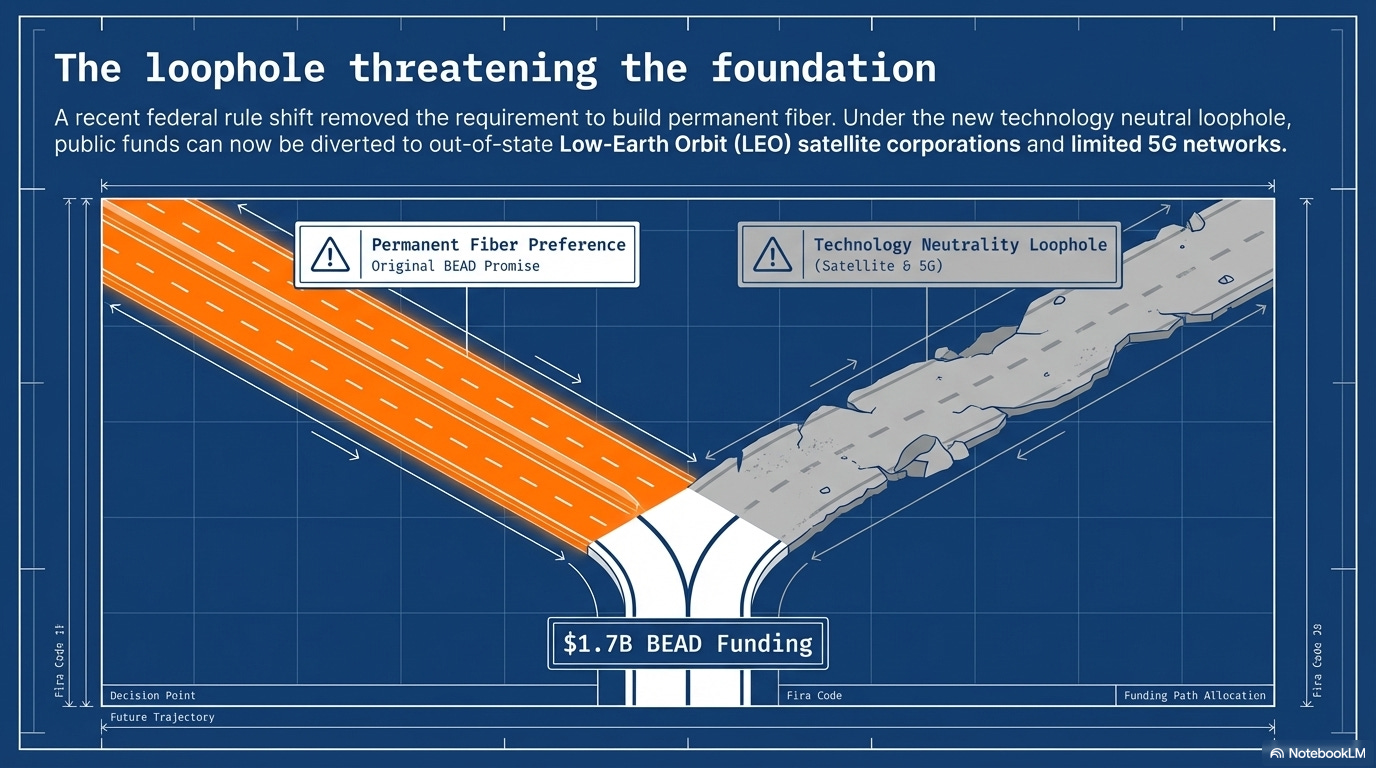
Covered on paper. Unserved in reality.
And what about your grandma who still lives out in the sticks?
Who is going to set up her Starlink dish?
You?
Is she a technical expert who understands how to troubleshoot satellite equipment and dish alignment?
Or is she going to stick that box in the corner and hope for the best?
And when gas, medicine, and food prices go up — will she pawn the Starlink dish to pay for her necessities? These are things I think about.
Because I know my Grandma Shirley wouldn’t be above doing exactly that.
This is not a policy debate.
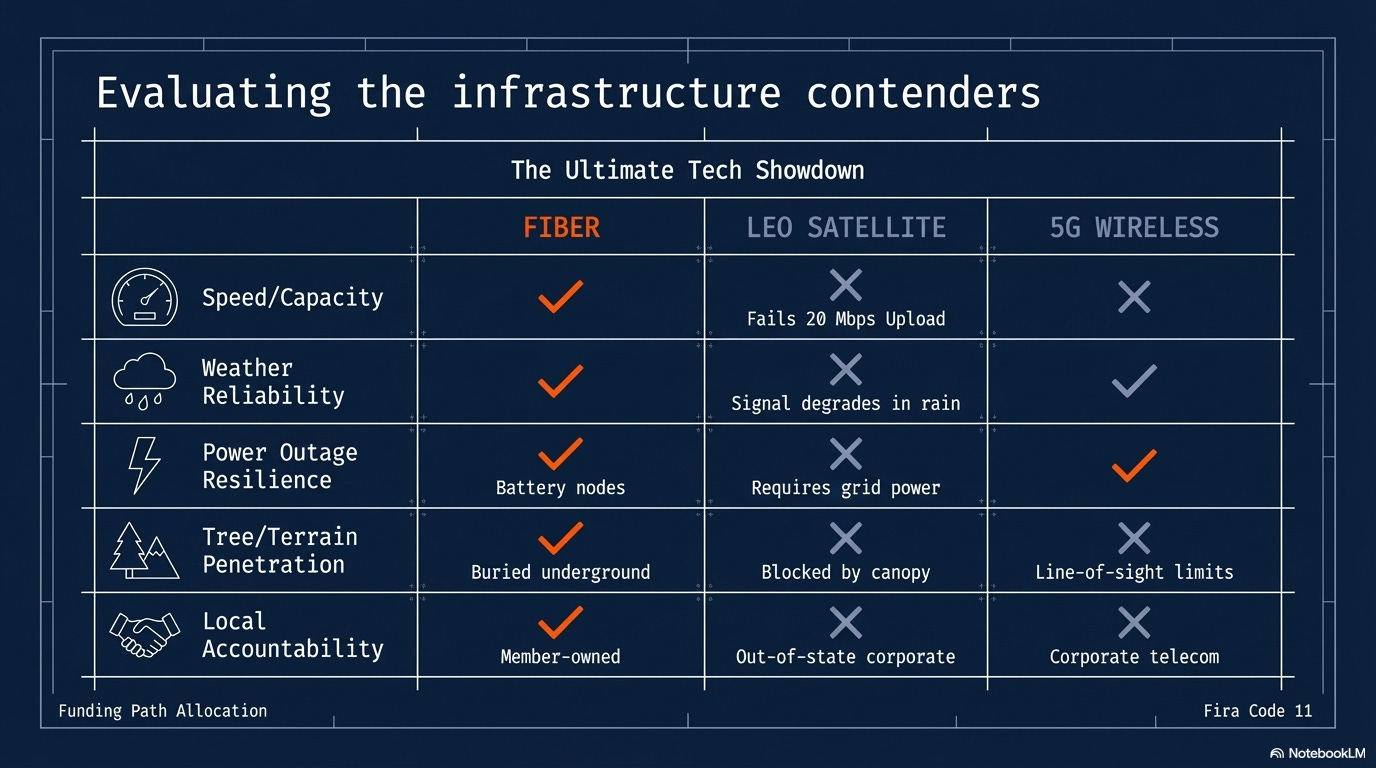
This is real people in our District being handed an expensive, complicated, weather-dependent piece of equipment by an out-of-state corporation — and being told that counts as “served.”
But it shouldn’t count.
The Money is leaving Missouri
According to researched information on the FCC site, somewhere between 10 and 20% of Missouri's BEAD expansion homes statewide are expected to be allocated to low Earth orbit satellite providers like Starlink and Amazon Kuiper.
That means one in five rural Missouri homes that federal broadband dollars were supposed to reach could end up assigned to out-of-state satellite corporations — including homes right here in HD123
Starlink is owned by Elon Musk. SpaceX is headquartered in California.
Amazon Kuiper is a subsidiary of Amazon — headquartered in Seattle, Washington.
T-Mobile is headquartered in Bellevue, Washington.
Shoot even Charter/Spectrum is headquartered in Stamford, Connecticut.
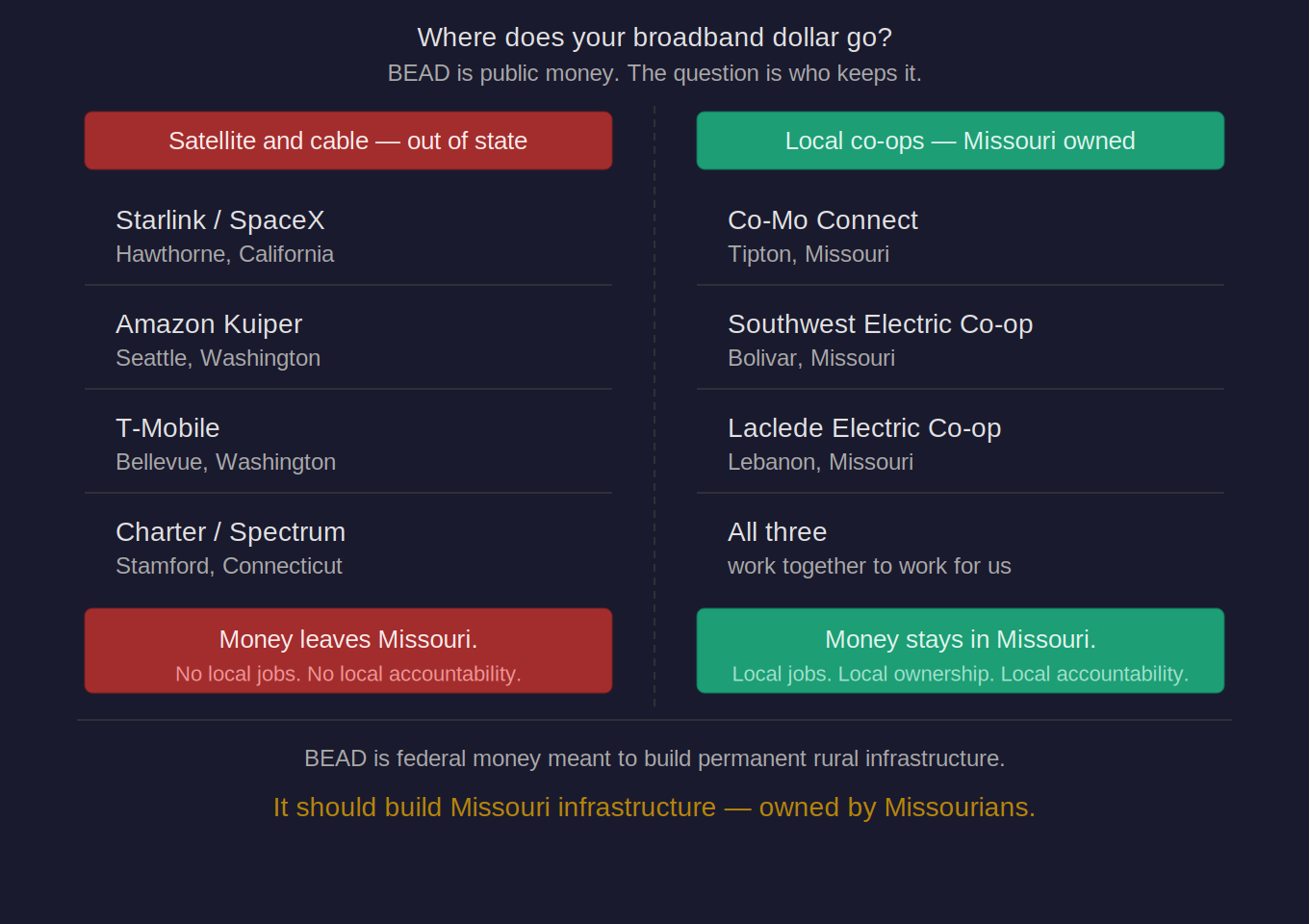
Every dollar that goes to these providers leaves Missouri.
Co-Mo Connect is owned by its members — your neighbors in Camden County.
Southwest Electric Cooperative is owned by its members.
Laclede Cooperative as well.
And all three local co-ops, work together to work for us.
The money stays here.
The infrastructure stays here.
The jobs stay here.
When something goes wrong, you talk to someone who lives here.
That is a fundamentally different relationship than a satellite dish pointed at a California corporation’s servers.
Co-Mo already proved the model works.
Starting in 2012, they built gigabit fiber to their membership before federal broadband funding programs existed — on their own, because their members needed it.
They have since used ARPA, and other grants to expand further into the Niangua Arm and beyond.
They are ready to keep going, shovel proverbially in hand. The technology is proven. The local accountability is built in.
What's standing in the way is federal program limbo — a restructured BEAD program with no clear timeline, out-of-state satellite companies demanding Missouri money without public accountability, and a state legislature that hasn't prioritized the fight.
What I’ll fight for in Jeff City
HD123 needs someone in Jeff City who understands this well enough to fight for the right outcome.
Not satellite.
Not 5G towers that can’t get through the tree line.
Fiber: in the ground — permanent, dedicated, locally owned, built to last generations.
Specifically that means: holding Missouri’s 81% fiber target as a floor and not letting SpaceX negotiate it down.
Requiring real performance guarantees from any provider that gets BEAD money.
Pushing for FCC map reform so satellite providers can’t claim coverage they can’t actually deliver.
Finding a fix to the pole attachment problem that’s blocking Co-Mo from expanding further into the Lake Area…
And keeping Missouri broadband dollars in Missouri.
The gap between my house and other folks in this District is not a technology problem.
The technology exists and it already works.
The gap exists because nobody in Jeff City is fighting hard enough to close it.
I’m running because I know what the fight looks like, I fought to modernize my architecture in the USAF for 20 years— and I will happily do it here, for our district.
If you would like to know more about BEAD and the hurdles that HD123 needs to clear to extend our broadband coverage I would direct you here: Google Document
Additionally, I would tell you to reach out to your local Co-Op and see what type of advocacy you can do on their behalf to ensure our services remain with our local providers.
And if you’re ready to help fight for real broadband in HD123 — reach out at electhutchmo123@gmail.com or find us at @HutchforMO on Facebook.
Cody Hutcheson | Candidate, Missouri House District 123 | Put People First. Always.
**More fun things I’m trying- tell me if you all like this video more than the audio only.
***If you are looking for my sources (and Acronym help!), please go to the link for the google document above and it will have everything for you.
Best explanation yet❣️ I’m a retired network engineer and cybersecurity architect: you are exactly right—fiber is reliable, satellite…not so much, especially when conditions are iffy. And satellite controlled by Elon Musk? He’s a menace to the world and skies.